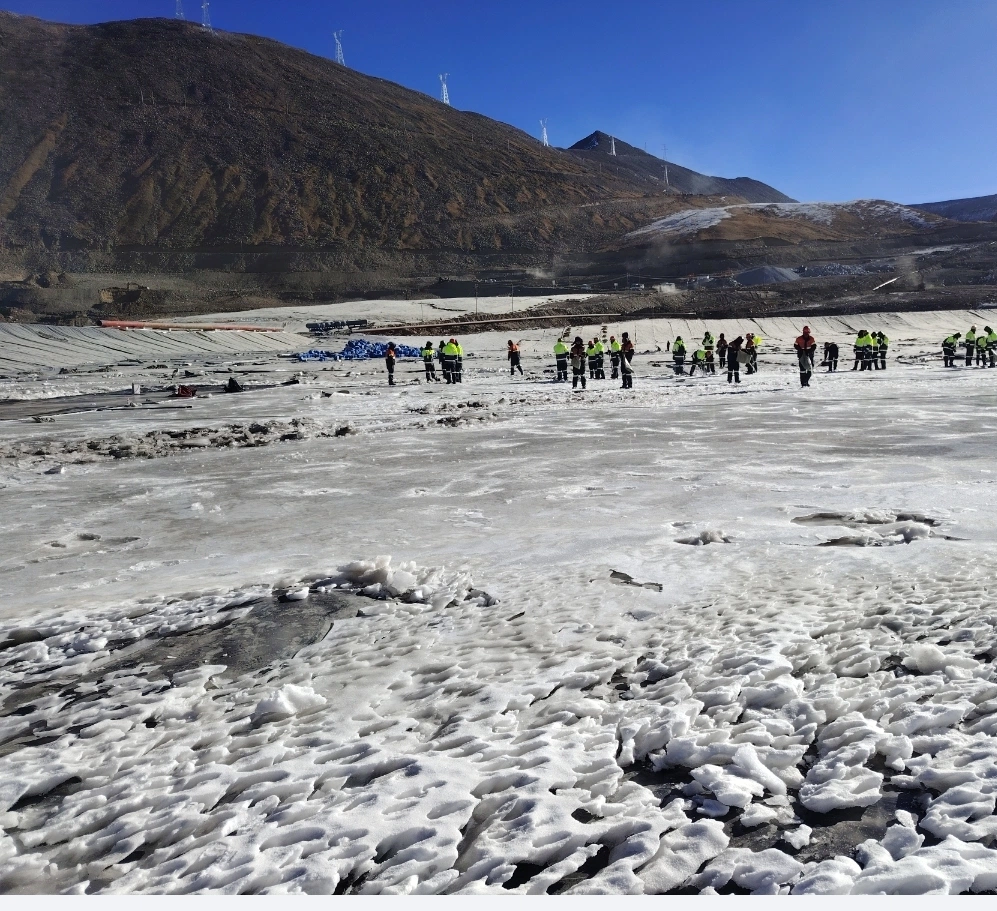
This photo shows an HDPE geomembrane installation site at a high-altitude location in Tibet. Large sheets of white impermeable membrane are being laid across a prepared basin, while workers in safety vests carry out seaming and inspection work under clear skies. Snow and frost residues on the ground indicate a low-temperature environment, which requires special attention during construction.
1. Site Conditions
High-altitude projects in Tibet typically face strong ultraviolet radiation, large day-night temperature swings, and occasional freezing temperatures. These conditions affect both material handling and welding quality. The membrane must be flexible enough to lay flat without cracking, and the seaming equipment must maintain a stable temperature during operation.
2. Material Selection
- HDPE (high-density polyethylene) geomembrane is commonly chosen for its chemical resistance, long-term durability, and ability to withstand UV exposure when formulated with carbon black or UV stabilizers.
- Thickness is selected according to the engineering design, commonly ranging from 1.0 mm to 2.0 mm depending on the application (reservoir, tailings, landfill or irrigation pond).
- Sheet size should be planned in advance to minimize on-site welding length and reduce the number of seams.
3. Construction Sequence
- Base preparation: compact and level the subgrade, remove sharp stones and debris, and lay a geotextile protective layer if required by the design.
- Membrane laying: unfold sheets from the lower part toward the upper part, leave enough slack for thermal contraction, and avoid dragging the membrane over rough surfaces.
- Seaming: use a hot-wedge welding machine for double-track seams. Test welding parameters on a sample strip before formal seaming, especially in cold or windy conditions.
- Inspection: conduct visual inspection, air-pressure testing of the double-track seam channel, and vacuum box or spark testing where applicable.
- Protection: cover completed areas with geotextile or soil cover promptly to reduce UV exposure and wind uplift risk.
4. Cold-Weather Precautions
- Avoid welding when the membrane surface is wet, frosted, or covered with snow; dry the seam area first.
- Increase welding temperature or reduce walking speed of the welder when ambient temperature is low, based on test-strip results.
- Store membrane rolls in a covered area and allow them to acclimate before unfolding to reduce brittleness.
- Workers should use slip-resistant footwear and avoid stepping directly on freshly welded seams before they cool down.
5. Summary
High-altitude and cold-region geomembrane projects demand careful planning of material selection, welding parameters, and construction scheduling. Following the above steps helps ensure the integrity of the impermeable layer and extends the service life of the project. For HDPE geomembrane specifications and pricing, please refer to the geomembrane product page or contact our sales team.





 " />
" />
 English