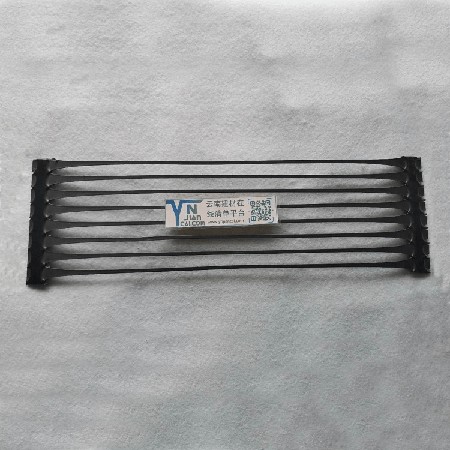
Uniaxial stretched geogrid, its main material parameter is tensile strength (unit KN). Please first confirm the required tensile strength. If it is not in the specification classification, you can fill it in the remarks, and we will quote according to the parameters you provide.
1. Uniaxial stretched geogrid is used to reinforce soft foundations: geogrid can quickly improve foundation bearing capacity, control the development of settlement, and the lateral confinement effect on road base can effectively distribute loads to a wider subbase, thereby reducing base thickness, reducing engineering costs, shortening construction period, and extending service life.
2. Uniaxial geogrid is used for reinforced asphalt or cement pavement: geogrid laid at the bottom of asphalt or cement pavement can reduce rut depth, extend pavement fatigue life, and can also reduce asphalt or cement pavement thickness to save costs.
3. Uniaxial geogrid is used to reinforce road embankment slopes and retaining walls: traditional embankments, especially high embankments, often require overfilling and the shoulder edges are not easy to compact, leading to later slope rainwater erosion, collapse and instability phenomena occurring from time to time. At the same time, gentler slopes are needed, occupying a large area, and retaining walls also have the same problem. Using geogrid to reinforce embankment slopes or retaining walls can reduce the occupied area by half, extend service life, and reduce cost by 20-50%.
4. Uniaxial geogrid is used to reinforce river, sea and sea dikes: can be made into gabions, then used together with grids, to prevent dikes from being eroded by seawater causing collapse. Gabions have permeability, can slow down wave impact, extend dike life, save manpower and material resources, and shorten construction period.
5. Uniaxial geogrid is used to treat landfills: geogrid used in combination with other geosynthetic materials to treat landfills can effectively solve problems such as uneven foundation settlement and derivative gas emissions, and can maximize the storage capacity of landfills.









 English