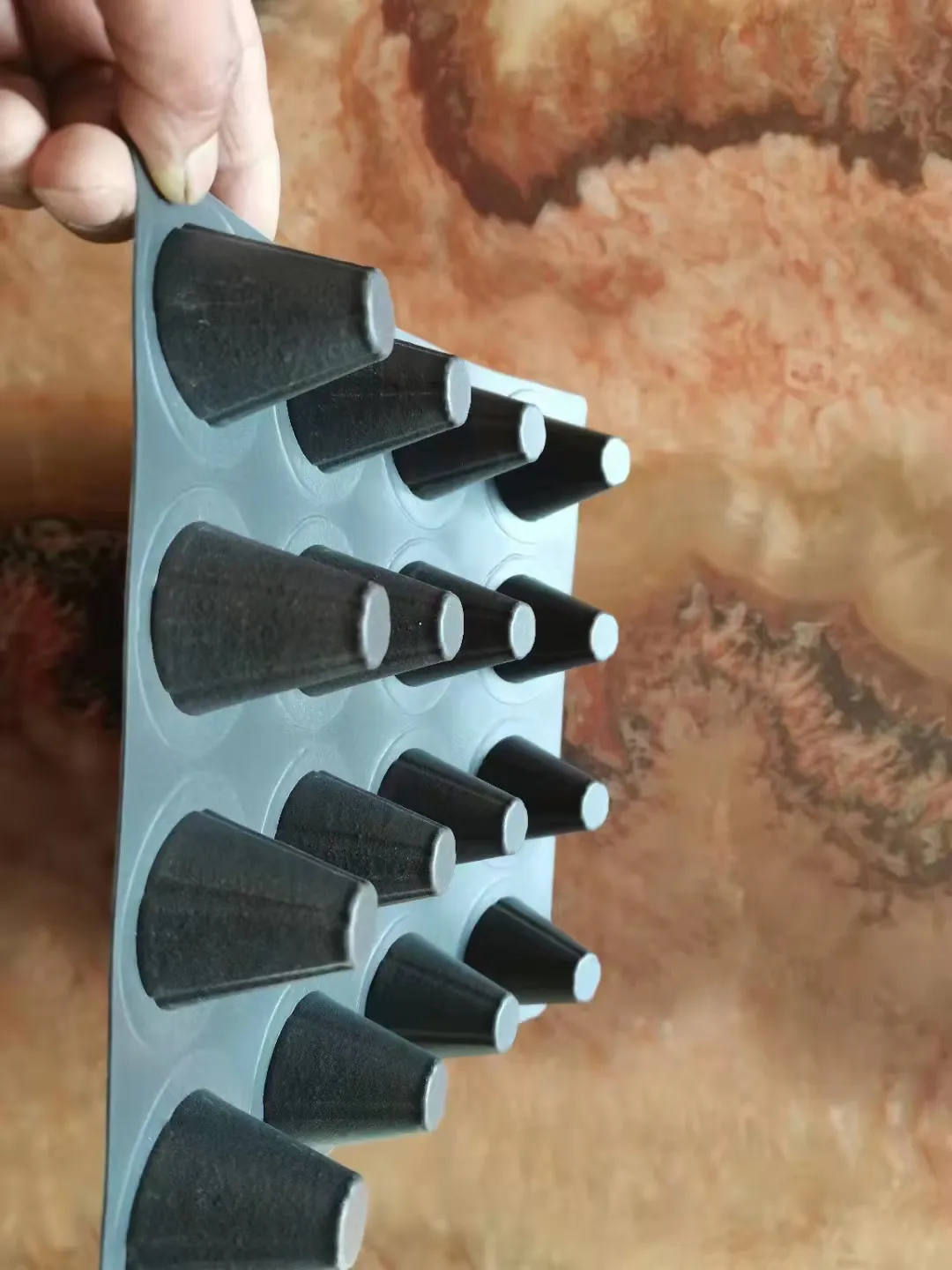
Plastic drainage board pre-compression reinforcement technology has been widely applied. Since the working environment of plastic drainage boards is mainly soft clay, there are many problems in studying the fouling characteristics of filter membranes using the gradient ratio method. A new fouling test method and an axial compression fouling test method were studied. The sedimentation problem in geotextile environment. Through axial compression fouling tests of multiple sets of filter membranes, and comparing the performance of plastic drainage board filter membranes after construction, the results show that after construction, the soil retained per unit area and permeability coefficient of the plastic membrane filter tank are vertical. The axial compression fouling test is the same as the post-construction plastic. The filter membrane of the drainage board is very tight, the first is slightly smaller than the second. In the case of plastic drainage board filter membrane blockage, silt, dredged fill and some special soft clays were tested, which have the characteristics of high water content and high clay particle content. The disposal method of Kunming drainage board is to combine plastic drainage board with vacuum preloading method for reinforcement. Plastic drainage board plays a triple role of drainage, filtration and heat insulation in reinforced soil. Under the action of vacuum suction, water from the foundation enters in one direction and enters the filter membrane through the soil layer. Soil particles also gather around the filter membrane of the soil layer. Plastic drainage is carried out under the action of vacuum suction. Particles larger than the filter membrane aperture are blocked by the filter membrane, and fine particles smaller than the filter membrane aperture adhere to the filter membrane due to molecular thermal motion, inertia, diffusion, retention, aggregation and static electricity. Part of the membrane surface is embedded in the pores of the filter membrane, part passes through the filter membrane, or is drained by water or retained on the central board, which will lead to membrane blockage. Filter membrane and central board, thereby weakening the role of plastic drainage board.
To solve the blockage problem in the application of plastic drainage boards, some researchers have improved construction technology, forming new anti-blockage vacuum preloading method [1], controllable ventilation vacuum preloading method [2], etc. From the perspective of repairing the silt layer, researchers tried to wash the silt layer by repeated suction and water absorption [3], and repeated washing with water [4], but the effect was not ideal. Xu Kai suggested using the In method [5], Benson CH et al. engaged in developing a plastic drainage board with high filtration performance to cover the filter membrane [6], in order to fundamentally solve the blockage problem. China's new anti-blockage plastic drainage board came out, and has been promoted and used in Tianjin, Jiangsu, Guangdong and other places. In summary, the blockage problem is a key issue affecting the drainage effect of plastic drainage boards, and testing the anti-blockage performance of filter membranes is of great significance. The internationally recognized geotextile sedimentation test method is the gradient ratio method developed by the US Army Corps of Engineers. The measured value is the head of the pressure gauge and the penetration of water. Since the working environment of plastic drainage board filter membranes is mainly clay and other soils with poor permeability, when using the gradient ratio method for blockage testing, due to the slow speed of water infiltrating into the soil, the head change of the piezometer is slow and stable. This takes several days, and it is difficult to accurately determine whether the piezometer head is stable, and large differences are prone to occur in piezometer head data at the same height.





 " />
" />

 English